Thank You Microsoft for the Sponsorship. I May Never Use Azure Again.
I want to say thank you first. Microsoft for Startups sponsorship helped my company, RockieStar, actually ship products. The credits were real. Azure compute was real.
I may still walk away.
Not out of anger. Not as a dramatic tantrum. But because on a random day in July, Azure billed us $44,530.72 in a single 24-hour window, I spent an entire month asking what happened, and nobody from Azure support could explain it.
When you run an indie software company, a $44k day that nobody can explain isn't just an inconvenience. If that single day had been a month, it would be $1.34 million—enough to bankrupt me for ten years.
The $44k day nobody can explain
On 28 July 2026, our Microsoft for Startups sponsorship subscription registered $44,530.72 in usage for one day, tied to GPT-5.6 Sol.
- Tracking ID:
2607200040000130 - Subscription ID:
2d119d2f-c7e5-4c7a-8d78-ba25d66087ef
I am not going to sit here and claim our token consumption was zero. Maybe part of that number was real usage. The problem is: I have no way of knowing.
Sponsorship billing in Azure is notoriously delayed. Cost data doesn't update in real time; it trickles in days or weeks after the fact. By the time you notice a spike in Cost Management, the damage is already done. You cannot throttle a runaway meter you cannot see.
Worse, when I escalated this to Azure Billing Support, Microsoft’s own support engineer admitted they have "limited visibility" into sponsorship subscription usage.
Think about how terrifying that is: Microsoft generated an invoice for nearly forty-five thousand dollars on a startup account, but their own billing department cannot see what actually incurred the charge. They printed a bill they cannot read.
This already happened once (and came out of pocket)
This wasn't even the first time Azure billing went completely dark before hitting us with a surprise invoice.
Late last year, we tested Anthropic Claude on Azure. We integrated the models and used them for development. For about one to two weeks, the Azure portal showed $0 in charges. Because the dashboard was silent, we naturally assumed the usage was either covered under our sponsorship tier or within free allocations.
Then, out of nowhere, Microsoft issued a direct invoice:
- Invoice Number:
G133459410 - Amount: $1,764.06 CAD
- Billing Period: 1–31 Dec 2025 (billed 9 Jan 2026)
- Account: Default Directory
Because we had a credit card on file for the tenant, Microsoft automatically charged the card within two business days. I had to pay that $1,764.06 out of pocket.
It’s the exact same movie every time: no real-time telemetry, zero proactive alerts, a portal that indicates nothing is wrong, followed by an aggressive charge. At $1.7k, it stings. At $44.5k in a single day, it is lethal.
A widespread pattern across the community
This isn’t an isolated glitch on my account. If you look at the official Azure Discord and developer forums, teams everywhere are running into massive billing anomalies with GPT-5.6 and Azure AI models—where charges wildly diverge from actual application logs:
Developers are watching their cloud bills explode with zero recourse. Just this past week, developer Leo Jing posted a warning to everyone in the community after their team was wrongly billed almost six figures:
"Hey everyone, just a heads up about using Azure AI models. Azure has overcharging issues, and getting a refund has been pretty much impossible so far. Last month we got wrongly charged $87,650 and we've been waiting for a month now with no solution. So think twice before using Azure AI models."
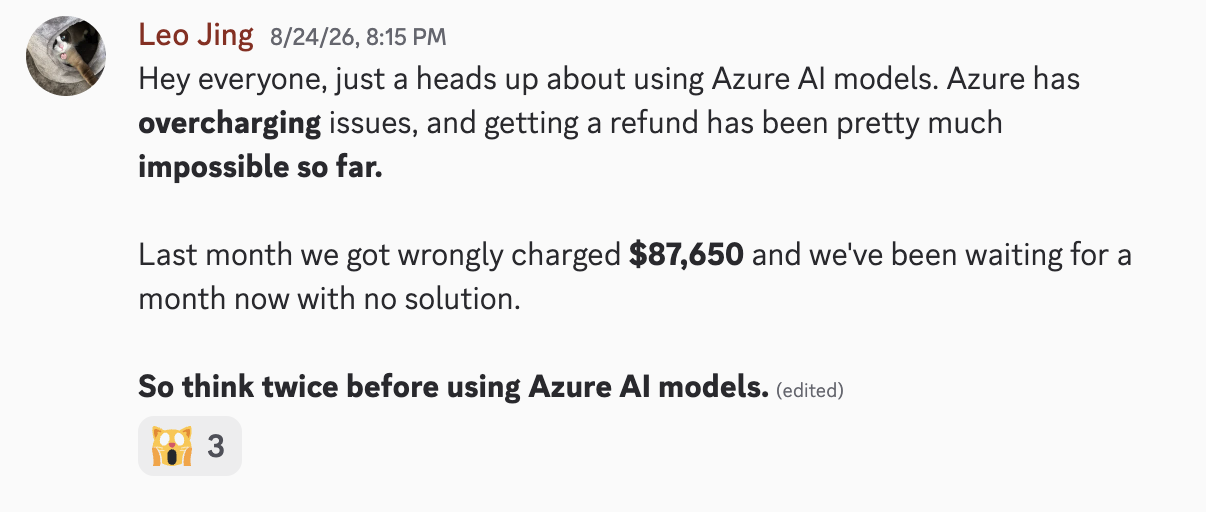
When multiple companies independently report five- and six-figure phantom bills on the same model family, it is no longer an edge case. It is an active platform hazard.
Support: 30 days of copy-paste silence
A support engineer initially picked up our ticket on 4 August. They explained that because an internal project had been reorganized or discontinued, case ownership was temporarily delayed.
From that point on, across almost an entire month, we received the exact same canned paragraph on 4 Aug, 5 Aug, 7 Aug, 13 Aug, 18 Aug, 22 Aug, and 25 Aug:
"The case is escalated. We are awaiting a response from the internal team. We will keep you informed."
I honestly don't care whether those replies were written by a human, an offshore contractor, or an automated bot. Use AI. Use whatever tooling you want. What matters is that nobody solved the problem.
Nobody named the responsible internal team. Nobody provided an itemized meter breakdown showing token count, region, or endpoint. Nobody reversed the $44,530.72 charge.
On 25 August, I wrote back clearly stating that if there was no meaningful response or resolution by Friday, 28 August, we would begin migrating our infrastructure off Azure.
Today is 31 August. Still absolute silence.
Satya Nadella has spoken repeatedly about building a culture of accountability and empathy. Looking at this support ticket, I see neither. No owner. No deadline. Zero empathy for a small team staring at a catastrophic invoice. Copy-pasting "we escalated" for four straight weeks is not customer support—it is a ticket-closing costume.
Windows App Store & Partner Center: Trapped in verification limbo
The cloud infrastructure issues are only half of the story. The developer experience on Microsoft's desktop ecosystem has been equally dispiriting.
I wanted to distribute our apps, ScreenKite and PilotCut, through the Microsoft Store.
For an indie developer, the Microsoft Store should be the ideal route on Windows. Sideloading requires purchasing an EV (Extended Validation) code signing certificate, which costs hundreds of dollars a year, involves clumsy hardware tokens, and is painful to maintain. The Store signs the binaries for you, avoiding the dreaded Windows SmartScreen warnings that terrify users. I saw OpenAI distributing the Codex desktop client through the Microsoft Store and thought it was finally mature enough for production.
It turned out to be another wall.
Our Partner Center account was already fully verified. Yet, when we prepared our release, we were asked to resubmit verification documents roughly two weeks ago. The dashboard promised a turnaround of one business day.
Two weeks later, the product release page remains stuck on Submission 1 in draft:
"You can't submit to the Store until your account is verified."
The "Submit for certification" button is permanently grayed out. I submitted support requests through Partner Center. Nobody replied. I have burned over 20 hours trying to get an already-verified publisher account to publish a simple app update.
Neither Apple’s App Store nor Google Play Console is flawless. But neither platform traps an established developer in a two-week "please wait 1 business day" loop with total radio silence on the support side. It feels unfinished, like an internal tool that was never polished for real external developers.
If this verification blocker isn't resolved within two days, I am closing our Windows Partner Center account entirely.
Why walking away is risk management
Sponsorship credits look generous on a landing page. In practice, the hidden costs will crush you:
- Delayed billing turns normal development into Russian roulette. When telemetry lags by days, a faulty meter or runaway process can print a $44k day before any alert triggers.
- Support cannot inspect their own bills. When Microsoft Billing claims "limited visibility" into Microsoft sponsorship accounts, there is zero safety net.
- Accountability doesn't exist. When a critical issue occurs, you get trapped in month-long canned escalation loops.
- Partner Center negates the platform advantage. The promise of skipping EV certificates is meaningless if the verification pipeline quietly stalls forever.
I can handle bugs. Software breaks; APIs have incidents. What I cannot accept as a founder is a bug combined with a black box and thirty days of ignored tickets.
So: thank you, Microsoft, for the sponsorship. Genuinely. It helped us get started.
Going forward, however, we are winding down our Azure footprint. Not out of spite, but as necessary risk management. The potential downside of an unmonitored, unexplained invoice is simply too high for a growing company to bear.
I am still asking for what is fair:
- A named human owner for Tracking ID
2607200040000130. - The itemized meter breakdown for 28 July 2026.
- A full credit of $44,530.72 for the GPT-5.6 billing anomaly.
- Partner Center verification completed on our existing publisher account.
Two days. If there is still no resolution, we will shut down our publisher account and complete our migration.
If you’ve experienced unexpected five-figure spikes on Azure AI sponsorship or had your verified publisher account trapped by Partner Center, please reach out to me at hello@realmikechong.com or on X @realmikechong. I’d like to know how many other builders are hitting this exact same wall.